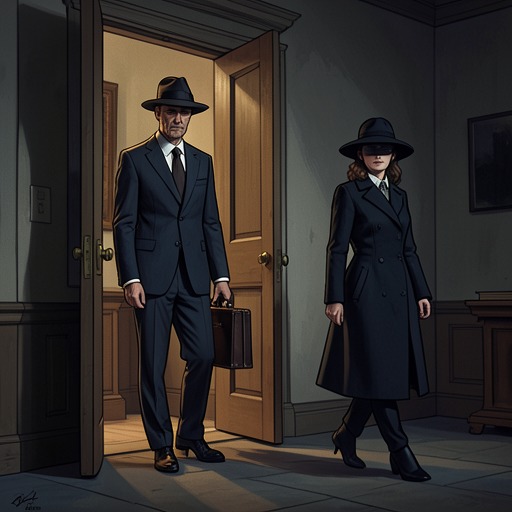
Sociedad Europea de Comercio Exterior office
Los pacientes del doctor GarcíaThe Sociedad Europea de Comercio Exterior office is a Madrid address where respectable commercial appearances conceal the overlapping work of Nazi fugitives, stolen property, and false identities. It becomes a practical hub for moving looted art and valuables out of Spain, but also the site where Rafael Cuesta Sánchez prepares to kill a man whose return threatens his assumed life.
Establishment and Hidden Function
Ingrid Weiss represented the company’s owners when the Sociedad Europea de Comercio Exterior was formally constituted before a notary. Rafael never learned who those owners were; the board secretary acted for them all. That opacity was not incidental to the office’s function. The company furnished a legitimate business identity for work whose principals and purposes remained concealed.
The office also belonged to the wider network around Clara Stauffer. At her house on Galileo 14, an office had been installed in the summer of 1945, and fugitives arriving from European prisons or crossing the Pyrenees were fed, given clothes, and connected with further arrangements. The network relied on parish baptismal certificates and contacts in the state administration to provide Spanish documentation. Its reach extended beyond shelter: Meg Williams and Manuel Arroyo Benítez saw the Stauffer organization as a stable escape route, likely connected to Argentina, though proving its operations and destinations remained essential to their investigation.
The Office as an Investigative Base
Manuel Arroyo Benítez, living under the names Adrián Gallardo and José Pacheco, used his access to Stauffer’s office to gather information. He cultivated the secretaries by bringing them the newspaper, sharing coffee, and running errands; when his vacation shift began on 15 June, their reliance on him made him almost another secretary. A small notebook bought with his pocket money was intended to hold what he learned. The secretaries also sent him to collect a baptismal certificate for José Pacheco Hernández, not telling him that it would help create his own identity papers.
Information from the house and office helped turn suspicion into a possible international case. Meg persuaded congressman Sal Burnstein that the network was more than a collection of isolated helpers, while Manuel and Pablo de Azcárate considered what evidence would be needed to establish the identities of Jean-Jules Lecomte and Horst Fuldner, the role of their Argentine visitors, and whether Stauffer did more than provide German fugitives with food and clothing. The suspected route depended on connections between Spanish documentation, Francoist institutions, and Argentina. Manuel was ultimately identified as the infiltrator needed to test those suspicions from within.
Commercial Cover and the Movement of Loot
The office later became a working base for Rafael and the operation involving Hans Lazar and Rolf Steinbauer. Rafael helped choose premises on Calle Jacometrezo, and the company’s plaque gave the address an ordinary commercial face. When Adrián Gallardo, the real man whose identity Rafael had taken, sought money in exchange for keeping silent, Rafael arranged to meet him at the office on 29 December. Adrián was so focused on the prospect of payment that he did not read the plaque identifying the company.
The office was also tied to the removal of Nazi loot. Rafael helped camouflage seven truck shipments between January and April. Works of art were detached from their frames, rolled, and hidden inside tubes disguised among building materials. Gold was melted into ingots; jewels went into double-bottomed boxes, and oranges served as another concealment. Larger objects—including statues, candlesticks, clocks, and religious artifacts taken from churches—required more elaborate concealment, prompting Rafael to arrange for a trusted coachbuilder to modify a truck floor. His skill made him useful to the operation, while the work placed him directly inside the transfer of stolen property.
The rewards arrived in envelopes from Rolf, increasing as the deliveries succeeded. Rafael deposited the money in small, varying sums across three bank accounts he had opened for the purpose, though he had not yet spent any of it. His growing participation was therefore both material and moral: the office turned his aptitude for concealment into paid work within a system he still hoped might be stopped at the French customs border.
The Office and Rafael’s Moral Crisis
The same respectable room acquired a darker use when Rafael learned that Adrián’s survival made him a danger. On 29 December 1949, Rafael reached the company office at seven in the evening, having spent the previous day studying its dimensions and the spacing between the furniture. He found a loaded .22-caliber Luger and silencer inside an inlaid wooden chest on the windowsill. A small flat key had been hidden inside the fourth volume of the Spanish translation of Goethe’s complete works.
Rafael’s knowledge of the room became part of the plan. He discovered an unseen shelf beneath the desk, large enough to hold the pistol with its silencer attached and positioned so that he could retrieve it quickly and quietly. The discovery suggested a method, but it also made the moral fact of his intention impossible to evade: as he recognized the weapon’s place and readiness, he recognized that he was behaving like a murderer. The office thus concentrates the novel’s transformation of an ordinary business address into a place where secrecy serves both escape and violence.